Lubricant Basics
Lubricants and Greases
Lubricant manufacture

Base oil
Category
Mineral base oil
Synthetic base oil
Major features
Viscosity and low-temperature properties, Additive solubility, Evaporation loss, Oxidization stability
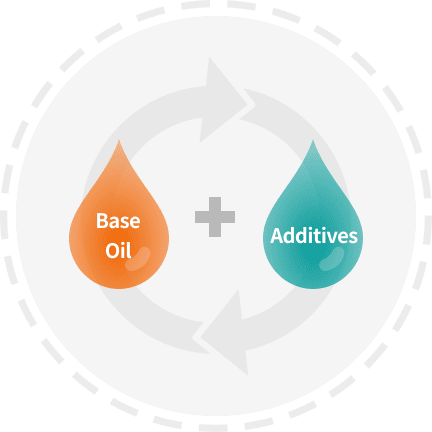
Additives
Oxidization inhibitor, wear resistance agent, pour point depressant, foam prevention agent, etc.

Thickener
Metal base, composite base, organic synthetic base, inorganic, etc.
Grease manufacture

Base oil
Category
Mineral base oil
Synthetic base oil
Major features
Viscosity and low-temperature properties, Additive solubility, Evaporation loss, Oxidization stability
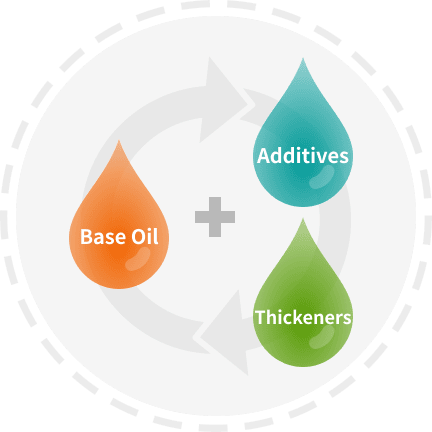
Additives
Oxidization inhibitor, wear resistance agent, pour point depressant, foam prevention agent, etc.

Thickener
Metal base, composite base, organic synthetic base, inorganic, etc.

Classification by Viscosity
Single-grade Oils
For some applications, when the temperature ranges in use are not very wide, single-grade motor oil is satisfactory; for example, lawn mower engines, industrial applications, and vintage or classic cars.
SAE Viscosity Grades for Engine Oils 1 -SAE J300 Dec 99
The actual viscosity grade of a lubricant is determined by the Society of Automotive Engineers, for example SAE-15W40 for a multigrade oil and SAE-40 for a monograde oil. The first number (15W) refers to the viscosity grade at low temperatures (W from winter), whereas the second number (40) refers to the viscosity grade at high temperature.
Multi-grade Oils
The temperature range the oil is exposed to in most vehicles, however, is too wide for single-grade oils, ranging from cold temperatures in the winter when the vehicle starts up to hot operating temperatures in summer weather. That's where multi-grade oils come in: by nature the oil will have a high viscosity when cold and a lower viscosity at the engine's operating temperature. The problem here is that during cold-starts the thick oil needs longer to get to the necessary engine parts and do its job, whereas at higher operating temperatures it might get too thin and the coating film could break in some places. To bring the difference in viscosities closer together, special polymer additives called viscosity index improvers (VIIs) are added to the oil. These additives are used to make the oil a multi-grade motor oil (e.g. 10W-40). The idea is to cause the multi-grade oil to have the viscosity of the base grade when cold and the viscosity of the second grade when hot. This enables one type of oil to be generally used all year. In fact, when multi-grades were initially developed, they were frequently described as 'all-season oil'.
Viscosity and Viscosity Index
What is viscosity?
One of the most important factors when selecting lubricants, defined as the number of seconds it takes for a set quantity of a sample to pass a certain length at a certain temperature. Various units can be used to measure viscosity depending on the measuring instrument, but the most common is “centistokes” (cSt). Furthermore, viscosity changes with temperature, so the temperature must be specified for the viscosity level to be meaningful. As conditions such as speed, temperature, and load vary for each device, they all require lubricant viscosities. If the viscosity of the oil used exceeds the required viscosity, it may cause damage due to excess operation, but if the viscosity is too low, the oil cannot form the required oil film, and scratching or other such problems may occur. In order to measure viscosity at cold temperatures other than by using ASTM D-445, the ASTM D-2602 method with a cold cranking simulator can be used. The test standard used to measure the viscosity of GS Caltex engine oil is ASTM D-5293.
What is the viscosity index?
The viscosity index shows the relationship between the oil’s viscosity and temperature. When the temperature rises, oil viscosity decreases, and vice versa. A high viscosity index means that temperature changes do not greatly affect viscosity.
Classification by Performance
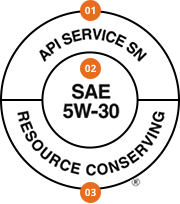
API'S CERTIFICATION MARK AND SERVICE SYMBOL
These identify quality motor oils for gasoline- and diesel-powered vehicles. Oils displaying these marks meet performance requirements set by U.S. and international vehicle and engine manufacturers and the lubricant industry. More than 500 companies worldwide participate in this voluntary program, which is backed by a marketplace sampling and testing program.
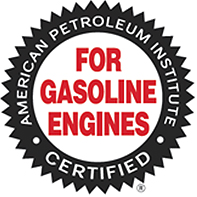
THE API CERTIFICATION MARK,
ALSO KNOWN AS THE “STARBUSRST”
An oil displaying this mark meets the current engine protection standard and fuel economy requirements of the International Lubricant Standardization and Advisory Committee (ILSAC), a joint effort of U.S. and Japanese automobile manufacturers. Automobile manufacturers recommend oils that carry the API Certification Mark. See the ILSAC STANDARD FOR PASSENGER CAR ENGINE OILS chart on the next page for descriptions of current and obsolete ILSAC standards.